Client Portal Login
 Pay Bill
The Same Decision, Read Twice
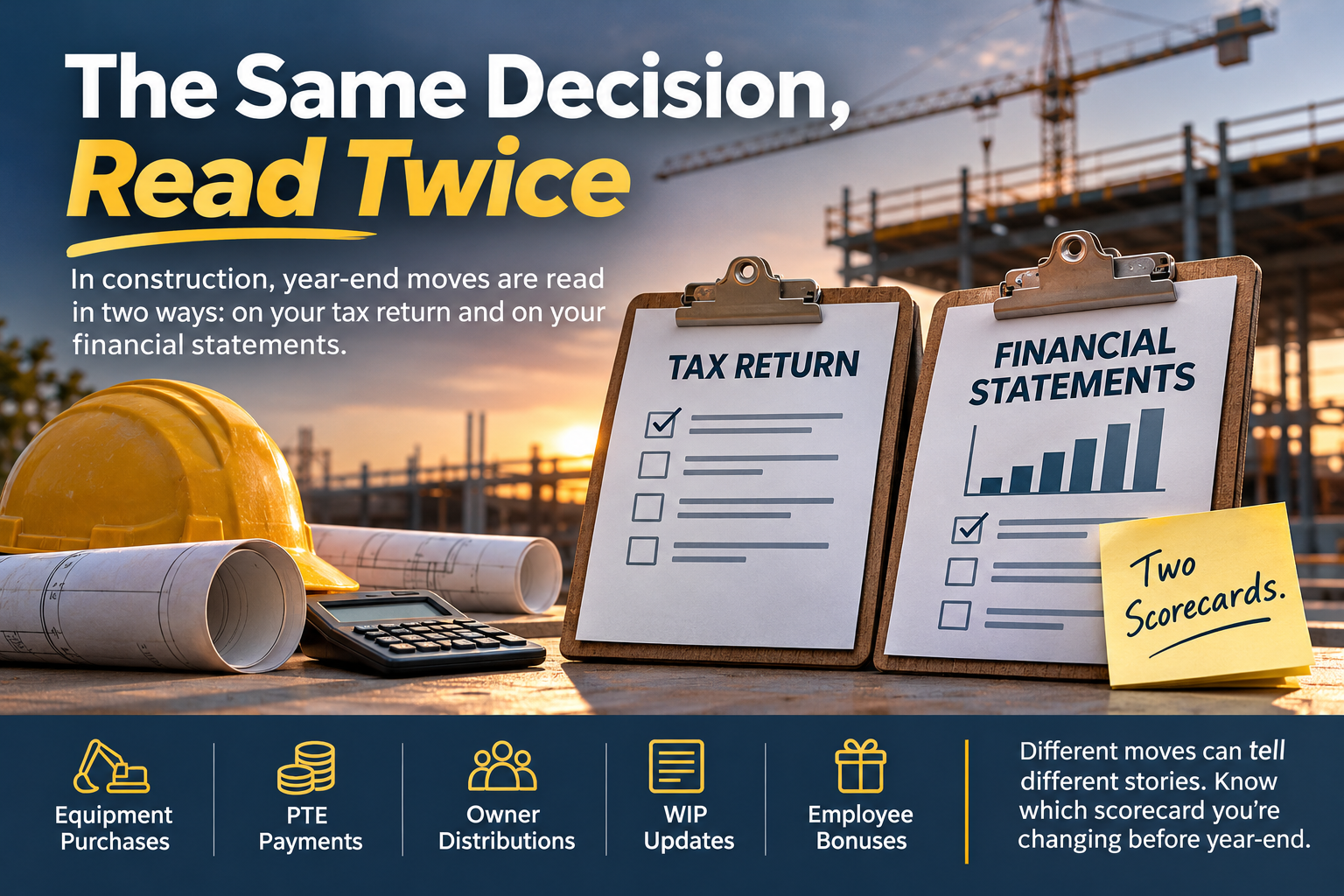
December is when many construction owners make their biggest tax decisions: whether to buy equipment, how much to pay in pass-through entity tax, what to distribute, and where the jobs really stand. Those choices show up on the tax return. They also show up in the year-end financial statements that banks and sureties use to decide how much credit and bonding capacity the company will have next year. Sureties, often called bonding companies, issue the performance and payment bonds that many projects require.
Most owners plan for one of those readers at a time. Some focus on reducing taxable income without seeing the effect on their statements. Others hold back on reasonable planning because they’re unsure how their bank or surety will react, without knowing where the lines actually are.
The same move can tell a very different story on the tax return than it does in the financial statements. Year-end planning in construction starts with knowing which story you’re changing.
Two Scorecards
The IRS is focused on taxable income. Sureties and banks read the financial statements differently. Their attention usually goes to:
- Working capital: current assets minus current liabilities, one of the first numbers a surety looks at when setting bonding capacity. Many sureties adjust it, excluding or discounting items such as related-party receivables, prepaid expenses, and older receivables. The number they rely on is often lower than the one on your balance sheet.
- Equity: what the company owns minus what it owes, often called net worth. Like working capital, sureties and banks may adjust it, so the figure they use can be lower than the one on your balance sheet.
- Profitability: not just this year’s result, but how consistent it has been.
- The WIP schedule: whether jobs are earning what they were bid to earn, and whether billings are reasonable compared with the work completed.
- Covenant ratios: for companies with bank debt, measures such as debt-to-equity or debt service coverage, calculated on specific line items defined in the loan agreement.
A move that improves one scorecard can weaken the other, or leave it untouched. That’s why the details are worth knowing before the year closes.
Start With Where the Jobs Stand
Before any planning decision, the numbers underneath it need to be as accurate as possible. In many construction companies, the percentage-of-completion and completed-contract schedules get their closest look only after year-end. If they aren’t updated until the books close in February, December decisions are being made on numbers that are potentially inaccurate. Even a December update is a moving target: the year isn’t finished, December’s costs and billings are still coming in, and estimates to complete that haven’t been reviewed in months can shift once someone looks closely. Getting the numbers to the point where they can support real planning takes work, which is why it pays to start before December.
This matters more in construction because the two scorecards may use different methods for the same jobs. Financial statements generally recognize profit as the work progresses. For tax purposes, some contractors that meet certain size and contract requirements can use the completed-contract method, which recognizes profit when a job is finished. The same year-end update can shift reported profit and taxable income by different amounts, and margin fade discovered in December leaves little time to respond.
How Common Year-End Moves Show Up
The table below summarizes how several common moves typically appear to each audience. The details depend on the company’s entity type, accounting methods, and financial statement presentation, so treat it as a starting point for a conversation rather than a rule.
| Year-end move | Tax return | Financial statements | What a surety or bank may notice |
|---|---|---|---|
| Equipment purchase | Federal deduction is often taken in full or in large part in the year it’s placed in service. California doesn’t follow federal bonus depreciation, so the state deduction is usually smaller and spread over more years | Recorded as an asset and depreciated over its useful life | Cash purchases reduce working capital; financing adds debt and can affect leverage or debt service ratios |
| California pass-through entity tax payment | Can reduce the owners’ overall tax burden; timing of payment matters | Reduces cash; presented either as an expense or as a distribution, depending on the company’s approach | Lower working capital and equity, whichever presentation is used |
| Owner distributions | No deduction at the company level | Reduces cash and equity directly | Among the most visible items; loan agreements may limit distributions |
| Year-end WIP update | May follow a different method, such as completed contract, depending on eligibility | Profit generally recognized as work progresses | Margin fade, underbillings, overbillings, and whether estimates have proven reliable |
| Employee bonuses | Generally deductible, subject to timing rules, especially for owners | Generally recorded as an expense | Little divergence: both scorecards show lower profit, and cash leaves either way |
The last row is the useful contrast. Some moves look the same to both audiences. Others look very different, and those are the ones worth modeling before December 31.
Questions to Answer Before December 31
- Is WIP current? Are the year-end estimates to complete realistic, and have the people running the jobs reviewed them?
- How are your covenants calculated? Which line items and definitions apply, and how much room do you have today?
- Where do working capital and equity stand compared with what your bank and, if you’re bonded, your surety expect?
- Will equipment be placed in service by year-end? Signing a purchase order isn’t enough. For tax purposes, the asset generally needs to be ready and available for use.
- How will PTE payments be presented in your financial statements, and is that something your bank or surety should understand in advance? Paying in December generally moves the federal deduction into this year without changing the amount of PTE tax owed. It’s also worth looking ahead to June: participating at full value requires a minimum prepayment by June 15, and falling short reduces the credit available to the owners.
- Would a conversation with your surety or banker help? Explaining a planned move ahead of time is usually easier than explaining a surprise afterward.
Two Readers, One Year-End
Tax savings are real, and so is the need for strong financial statements. Most of the time, owners don’t have to choose one over the other. They need to know which scorecard each decision affects, and by how much, while there’s still time to adjust.
Every construction company is building something different. The best decisions are made in the context of your goals, your backlog, your cash flow, your team, and your long-term vision for the business. At Linkenheimer, we work alongside construction owners to connect operations, financial insight, and long-term strategy, so they can make sound decisions with confidence.
Ready to talk through your year-end decisions? Contact us to schedule a planning conversation.
 Andy Vedder