2023

IRS Announces Tax Relief For Victims Of Winter Storms In California

Victims of severe winter storms, flooding, and mudslides in California beginning January 8, 2023, now have until May 15, 2023, to file various individual and business tax returns and make tax payments, the Internal Revenue Service announced today.

Following the disaster declaration issued by the Federal Emergency Management Agency, individuals and households affected by severe winter storms, flooding, and mudslides that reside or have a business in Alameda, Colusa, Contra Costa, El Dorado, Fresno, Glenn, Humboldt, Kings, Lake, Los Angeles, Madera, Marin, Mariposa, Mendocino, Merced, Mono, Monterey, Napa, Orange, Placer, Riverside, Sacramento, San Benito, San Bernardino, San Diego, San Francisco, San Joaquin, San Luis Obispo, San Mateo, Santa Barbara, Santa Clara, Santa Cruz, Solano, Sonoma, Stanislaus, Sutter, Tehama, Tulare, Ventura, Yolo, and Yuba counties qualify for tax relief.

The declaration permits the IRS to postpone certain tax-filing and tax-payment deadlines for taxpayers who reside or have a business in the disaster area. For instance, certain deadlines falling on or after January 8, 2023, and before May 15, 2023, are granted additional time to file through May 15, 2023. As a result, affected individuals and businesses will have until May 15 to file returns and […]

By |2023-01-16T18:17:48+00:00January 16th, 2023|ca, CA tax, california, disaster, irs|0 Comments

SECURE 2.0 Law May Make You More Secure In Retirement

A new law was recently signed that will help Americans save more for retirement, although many of the provisions don’t kick in for a few years. The Setting Every Community Up for Retirement Enhancement 2.0 Act (SECURE 2.0) was signed into law on December 29, 2022.

SECURE 2.0 is meant to build on the original SECURE Act of 2019, which made major changes to the required minimum distribution (RMD) rules and other retirement provisions.

Here are some of the significant retirement plan changes and when they’ll become effective:

  • The age for beginning RMDs is going up. Employer-sponsored qualified retirement plans, traditional IRAs and individual retirement annuities are subject to RMD rules. They require that benefits start being distributed by the required beginning date. Under the new law, the age distributions must begin increases from age 72 to age 73 starting on January 1, 2023. It will then increase to age 75 starting on January 1, 2033.
  • There will be higher “catch-up” contributions for 401(k) participants ages 60 through 63. Currently, participants in certain retirement plans can make additional catch-up contributions if they’re age 50 or older. The limit on catch-up contributions to 401(k) plans […]
By |2023-01-04T17:53:24+00:00January 4th, 2023|retirement|0 Comments

The Standard Business Mileage Rate Is Going Up In 2023

Although the national price of gas is a bit lower than it was a year ago, the optional standard mileage rate used to calculate the deductible cost of operating an automobile for business will be going up in 2023. The IRS recently announced that the 2023 cents-per-mile rate for the business use of a car, van, pickup or panel truck is 65.5 cents. These rates apply to electric and hybrid-electric automobiles, as well as gasoline and diesel-powered vehicles.

In 2022, the business cents-per-mile rate for the second half of the year (July 1 – December 31) was 62.5 cents per mile, and for the first half of the year (January 1 – June 30), it was 58.5 cents per mile.

How rate calculations are done

The 3-cent increase from the 2022 midyear rate is somewhat surprising because gas prices are currently lower than they have been. On December 29, 2022, the national average price of a gallon of regular gas was $3.15, compared […]

By |2023-01-04T17:01:48+00:00January 4th, 2023|business, mileage|0 Comments

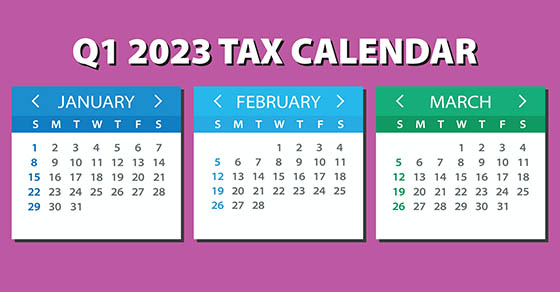
2023 Q1 Tax Calendar: Key Deadlines For Businesses And Other Employers

Here are some of the key tax-related deadlines affecting businesses and other employers during the first quarter of 2023. Keep in mind that this list isn’t all-inclusive, so there may be additional deadlines that apply to you. If you have questions about filing requirements, contact us. We can ensure you’re meeting all applicable deadlines.

January 17 (The usual deadline of January 15 is on a Sunday and January 16 is a federal holiday)

  • Pay the final installment of 2022 estimated tax.
  • Farmers and fishermen: Pay estimated tax for 2022. If you don’t pay your estimated tax by January 17, you must file your 2022 return and pay all tax due by March 1, 2023, to avoid an estimated tax penalty.

January 31

  • File 2022 Forms W-2, “Wage and Tax Statement,” with the Social Security Administration and provide copies to your employees.
  • Provide copies of 2022 Forms 1099-NEC, “Nonemployee Compensation,” to recipients of income from your business where required.
  • File 2022 Forms 1099-MISC, “Miscellaneous Income,” reporting nonemployee compensation payments in Box 7, with the IRS.
  • File Form 940, “Employer’s Annual Federal Unemployment (FUTA) Tax Return,” for 2022. If your undeposited tax is $500 or less, you […]
By |2022-12-28T16:02:21+00:00December 28th, 2022|tax deadlines|0 Comments
Go to Top